

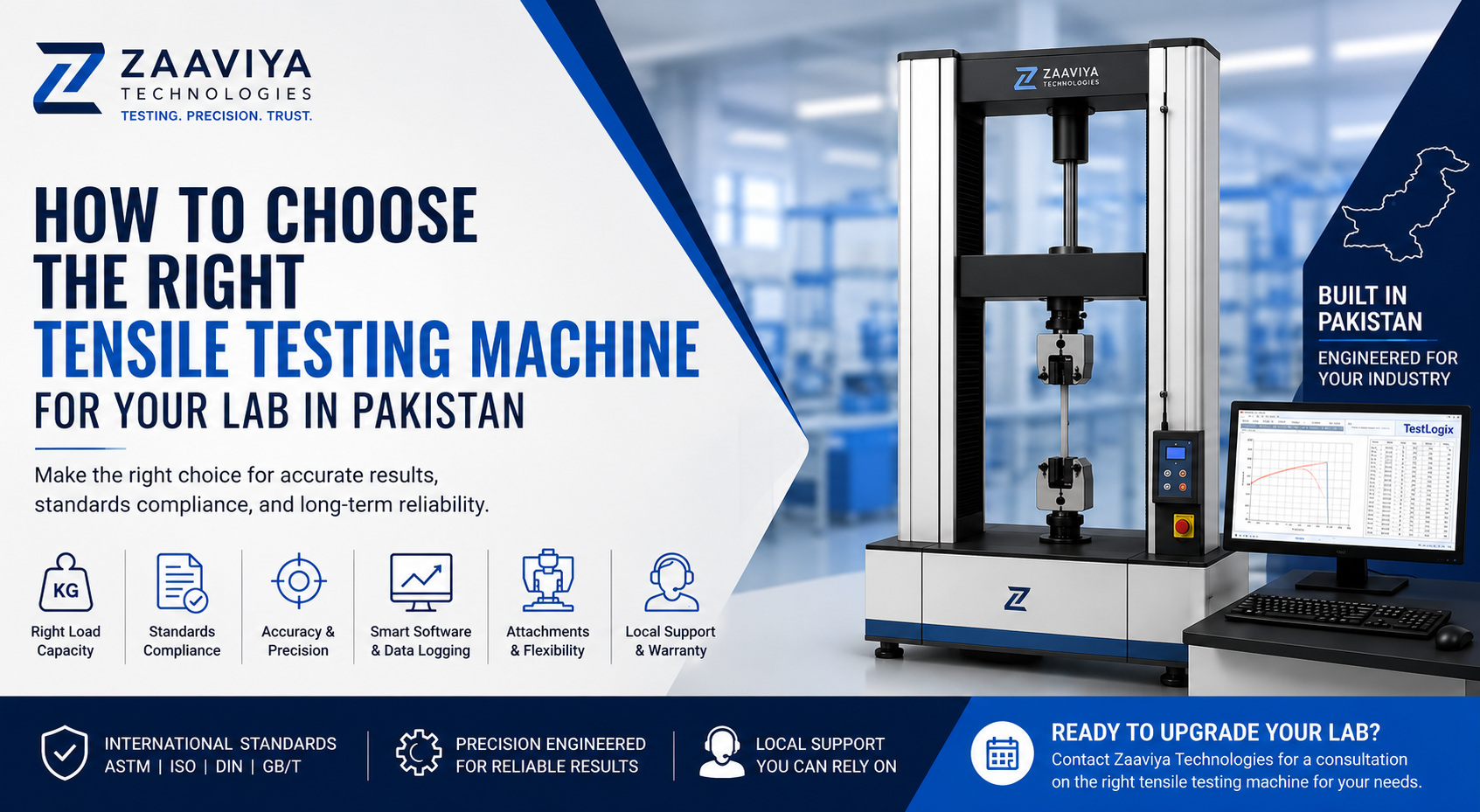
If you run a quality control lab, R&D facility, or production line in Pakistan, chances are you’ve faced this question at some point: which tensile testing machine actually fits your material, your budget, and your standards? With plastics, metals, rubber, textiles, and packaging industries all growing across Lahore, Karachi, and Faisalabad, demand for a reliable tensile testing machine in Pakistan has never been higher — but not every machine on the market is built for the same job.
A tensile testing machine, often called a universal testing machine (UTM), measures how a material behaves under pulling, compression, bending, or peeling forces. It tells you the tensile strength, elongation, yield point, and modulus of a sample — numbers that decide whether a batch of raw material or a finished product passes quality control or gets rejected. Get the wrong machine, and you either overpay for capacity you’ll never use, or underbuy and end up with inaccurate results that cost you customers.
What Does a Tensile Testing Machine Actually Do?
At its core, a universal testing machine applies a controlled force to a sample — plastic, metal, rubber, paper, or a medical device — until it stretches, breaks, or deforms. Sensors capture the load and displacement in real time, and the software converts that into a stress-strain graph. From this graph, engineers read off tensile strength, elongation at break, and other mechanical properties required by international standards like ASTM, ISO, DIN, and GB/T.
This is why the machine isn’t just lab equipment — it’s a compliance tool. Export-oriented manufacturers in Pakistan’s plastic, textile, and metal sectors often can’t ship a product internationally without test reports that reference these standards.
Key Factors to Consider Before You Buy
- Load Capacity and Material Type Match the machine’s load cell range to your material. A textile or thin-film plastic sample needs a much lower capacity than a steel rebar or structural component. Buying a machine with far more capacity than you need wastes budget; buying too little means you can’t test your heaviest materials at all.
- Standards Compliance Confirm the machine and its software can generate reports aligned with the specific standard your buyers or regulators require — ASTM D638 for plastics, ASTM A615 for rebar, ISO 527, or others. A machine that can’t produce standard-compliant reports isn’t much use in an audit.
- Accuracy and Precision Components Look at the load cell precision, the positioning system (precision ballscrews are more accurate than basic leadscrews), and whether the machine uses a high-accuracy AC servo motor. These details determine repeatability — how consistent your results are, test after test.
- Software and Data Logging Modern labs need more than a printed graph. Real-time data logging, automatic Excel reporting, and user rights management save hours of manual work and reduce human error, especially in labs running multiple shifts.
- Attachments and Flexibility An extensometer attachment, interchangeable grips, and custom fixtures let one machine handle tensile, compressive, tear, peel, and elongation tests across different materials — useful if your lab tests more than one type of product.
- Local Support and Warranty This is where many labs get burned. Imported machines can take weeks for spare parts or technical support, causing costly downtime. A tensile testing machine manufactured in Pakistan with local engineers, on-ground calibration support, and readily available spare parts is often the more practical long-term choice — especially for labs that can’t afford extended downtime during audits or production deadlines.
Common Mistakes Labs Make
Many first-time buyers focus only on price and overlook after-sales support, leading to machines sitting idle when something breaks. Others buy a generic UTM without checking whether its software actually supports the ASTM, ISO, or DIN standard their industry requires — only to discover this after the machine arrives.
Why a Locally Engineered UTM Makes Sense
Locally manufactured tensile testing machines, like those built by Zaaviya Technologies, are designed specifically around the needs of Pakistan’s plastic, metal, rubber, paper, and medical device industries. Features like precision ballscrews, high-accuracy servo motors, real-time graph display, and TestLogix software — built to work with ASTM, ISO, DIN, and GB/T standards — mean you get international-standard testing without the long import lead times or costly overseas servicing.
If you’re evaluating options, it’s worth requesting a demo or consultation before committing. A good supplier will help you match load capacity, accessories, and software to your actual testing needs — not just sell you the most expensive model on the shelf.
Ready to find the right machine for your lab? Contact Zaaviya Technologies for a consultation on tensile testing machines built and supported locally in Pakistan.
Frequently Asked Questions
1. What is the difference between a tensile testing machine and a universal testing machine?
They are essentially the same type of equipment. A tensile testing machine is named after its most common use—measuring tensile strength. A universal testing machine (UTM) can also perform compression, bending, peel, and other mechanical tests.
2. How much does a tensile testing machine cost in Pakistan?
The price depends on the machine’s load capacity, accuracy, software, and optional accessories such as extensometers. Locally manufactured machines are usually more cost-effective than imported models because they avoid high shipping and import costs.
3. Which industries in Pakistan use tensile testing machines?
Tensile testing machines are widely used in the plastics, metals and steel, rubber, packaging and paper, textile, and medical device industries for quality control and material testing.
4. Can one machine test both plastic and metal samples?
Yes. A universal testing machine can test both plastic and metal samples when it is equipped with the correct load capacity and suitable grips or fixtures for each material.
5. Why choose a locally manufactured testing machine over an imported one?
Locally manufactured machines offer faster delivery, quick access to spare parts, and reliable local technical support. This helps reduce downtime and keeps your production and testing running smoothly.